Clinical Decision-Making: Training Through Virtual Patient Cases
Clinical decision-making is arguably the most important skill a physician develops. It encompasses the entire process from a patient's initial presentation through history-taking, physical examination, investigation ordering, differential diagnosis, and treatment planning. Unlike factual medical knowledge, which can be memorized, clinical reasoning must be practiced in context, repeatedly, across diverse scenarios.
The Deliberate Practice Framework
Research on expertise development shows that deliberate practice, not merely experience, drives skill improvement. Deliberate practice requires four elements: a defined task, immediate feedback, opportunity for repetition, and progressive difficulty. Virtual patient cases provide all four. Each case presents a defined clinical problem. The system provides immediate feedback on diagnostic and treatment decisions. Students can repeat cases or attempt similar ones. Case libraries offer progressively more complex scenarios as competence develops.
In contrast, clinical rotations provide excellent exposure but limited deliberate practice. A student cannot ask to see another patient with the same condition to practice their approach. Cases arrive unpredictably, feedback is often delayed, and repetition of specific scenarios is impossible.
Building Differential Diagnosis Skills
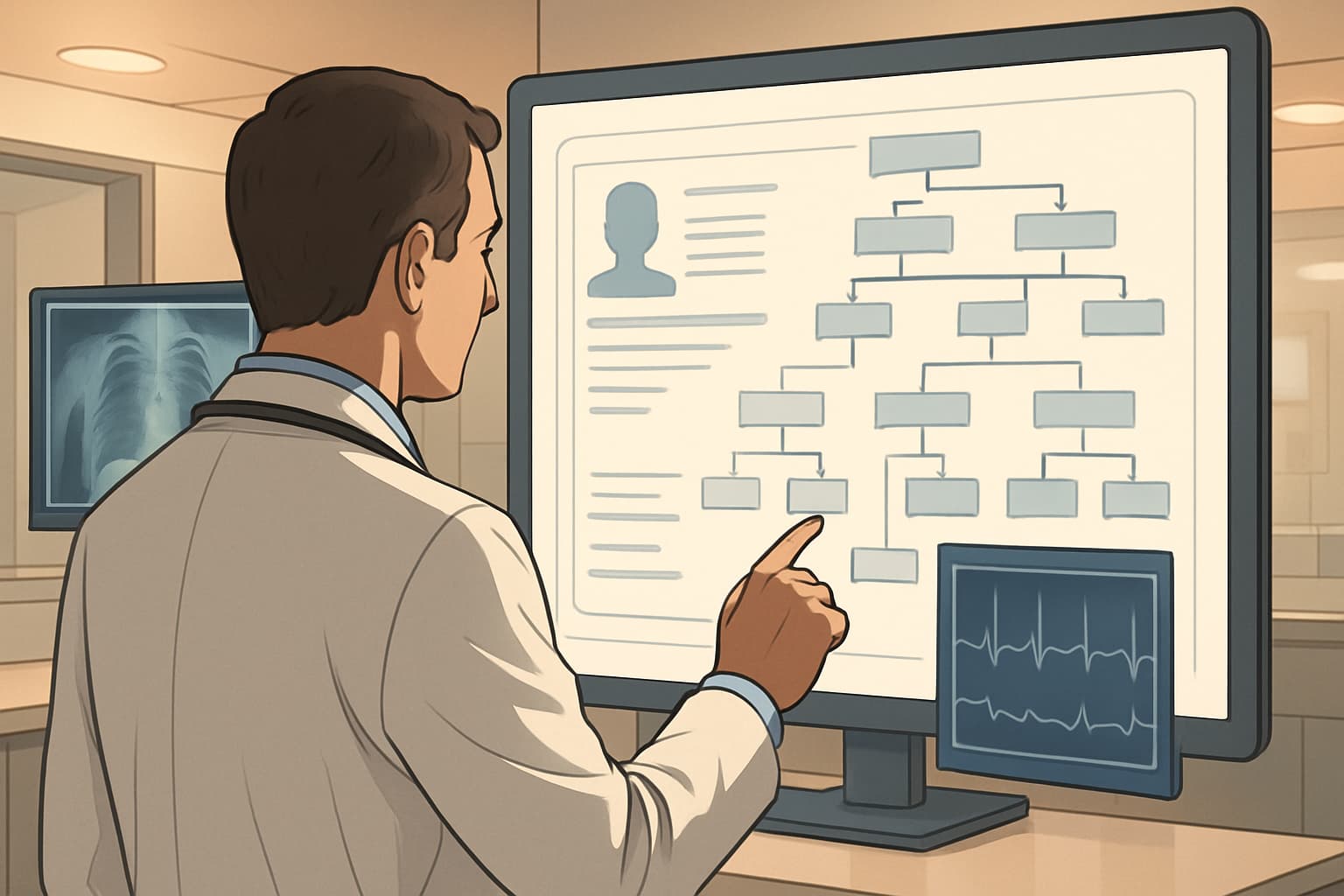
When a virtual patient presents with shortness of breath, the student must consider cardiac causes (heart failure, pericardial effusion), pulmonary causes (pneumonia, pulmonary embolism, COPD exacerbation), metabolic causes (diabetic ketoacidosis, severe anemia), and neuromuscular causes (Guillain-Barre, myasthenia gravis). Systematic evaluation of each possibility, guided by history and examination findings, is the essence of differential diagnosis.
Virtual cases force students through this systematic process. They cannot skip to the answer; they must gather information, weigh evidence, and justify each diagnostic step. Over time, this builds the clinical reasoning patterns that experienced physicians deploy instinctively.
Specialty-Specific Training
Clinical reasoning varies across specialties. A cardiologist evaluating chest pain follows different cognitive pathways than a gastroenterologist evaluating abdominal pain or a neurologist evaluating headache. Comprehensive virtual patient libraries provide cases across multiple specialties, allowing students to develop specialty-specific reasoning patterns before committing to a career path.
This breadth of exposure is particularly valuable in the pre-clinical years, when students are building foundational clinical skills across all disciplines. A student who has worked through cases in cardiology, pulmonology, gastroenterology, nephrology, endocrinology, and other specialties enters clinical rotations with a broader diagnostic framework than one who has only studied theory.
From Stable Cases to Emergency Scenarios
Clinical decision-making under time pressure adds cognitive load that fundamentally changes the reasoning process. Virtual patient platforms that include both stable outpatient cases and acute emergency scenarios prepare students for the full spectrum of clinical decision-making. A student might practice a routine hypertension management case one day and an acute myocardial infarction the next, developing the flexibility to adjust their reasoning speed and depth based on clinical urgency.
Measuring Reasoning Quality
One of the advantages of virtual patient platforms over traditional case studies is the ability to measure reasoning quality, not just diagnostic accuracy. The system tracks which questions the student asks, in what order, and how efficiently they narrow the differential. Two students might both reach the correct diagnosis of pneumonia, but one might have asked the right questions immediately while the other ordered unnecessary tests and considered unlikely diagnoses. This process evaluation provides insights that outcome-only assessment cannot capture.