How Virtual Patients Transform OSCE Preparation for Medical Students
The Objective Structured Clinical Examination (OSCE) has become the standard format for assessing clinical competency in medical education worldwide. Its multi-station design, standardized patient interactions, and structured assessment criteria create a more reliable measure of clinical skill than traditional examinations. For medical students, OSCE performance reflects not just knowledge but the integrated clinical skills — history-taking, physical examination, clinical reasoning, and communication — that define readiness for clinical practice. Virtual patient simulation has emerged as one of the most effective tools for systematic OSCE preparation.
The Structure of OSCE Preparation Challenges
OSCE preparation is difficult because it requires practice in performing clinical skills under time pressure across a wide variety of presenting complaints. A single OSCE may include stations covering chest pain, abdominal examination, psychiatric assessment, procedural skills, data interpretation, and breaking bad news. No student can gain sufficient real clinical exposure across all of these domains in the time available before their examination.
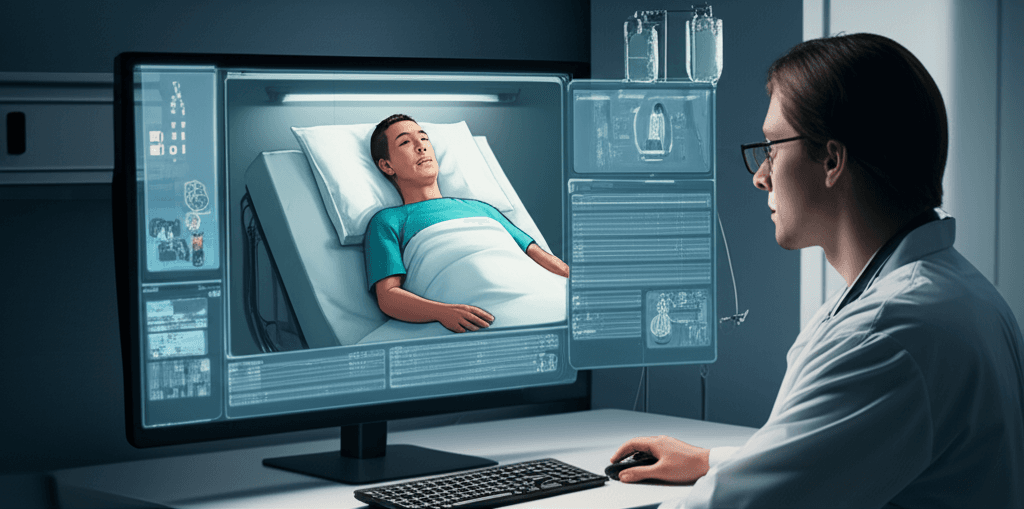
Traditional preparation methods — reading, watching videos, practicing with peers — provide incomplete preparation. Reading builds knowledge but not performance. Peer practice lacks the authenticity of a real clinical encounter. Virtual patient simulation provides authentic, structured practice that closely mimics the OSCE station format: a presenting patient, limited time, and specific tasks to complete.
Virtual Patients as OSCE Station Proxies
Virtual patient cases can be explicitly designed to mirror common OSCE station types. A history-taking virtual patient presents with a chief complaint and responds to clinical questions in a realistic, standardized way. The student practices structured history-taking — history of presenting complaint, past medical history, medications, allergies, social history, family history, systems review — and receives feedback on what they covered and what they missed.
Communication stations are particularly well-served by virtual patient simulation. Explaining a new diagnosis, discussing a sensitive finding, or counseling a patient about a lifestyle change all require communication skills that improve with practice. Virtual patients who respond with realistic emotions, questions, and concerns provide authentic practice that pure scripted role-playing with peers cannot match.
Systematic Coverage of Clinical Presentations
One of the most significant advantages of virtual patient simulation for OSCE preparation is the ability to systematically cover the full breadth of clinical presentations that may appear in the examination. Students can work through dozens of cases across multiple specialties over the weeks before their OSCE, identifying personal knowledge and skill gaps as they practice.
Tracking performance data across multiple virtual patient cases reveals patterns that targeted study can address. A student who consistently performs poorly on respiratory presentations can focus additional practice on those cases, while a student who struggles with patient communication can use targeted communication-focused cases to build confidence. This data-driven approach to OSCE preparation is more efficient than generalized review.
Reducing OSCE Anxiety Through Simulation Practice
Performance anxiety is a significant source of OSCE underperformance. Students with equivalent clinical knowledge often perform differently depending on how they manage the time pressure and interpersonal dynamics of OSCE stations. Repeated virtual patient practice reduces performance anxiety by making the OSCE format familiar. Students who have completed dozens of structured clinical encounters in simulation approach the OSCE with practiced routines rather than improvised responses.
Programs that deliberately simulate OSCE conditions — timed stations, explicit transition signals, strict task lists — provide the closest preparation possible. The students who perform best in OSCEs are typically those who have invested the most systematic practice time, and virtual patient platforms provide the structured, high-volume practice environment that makes that preparation possible.