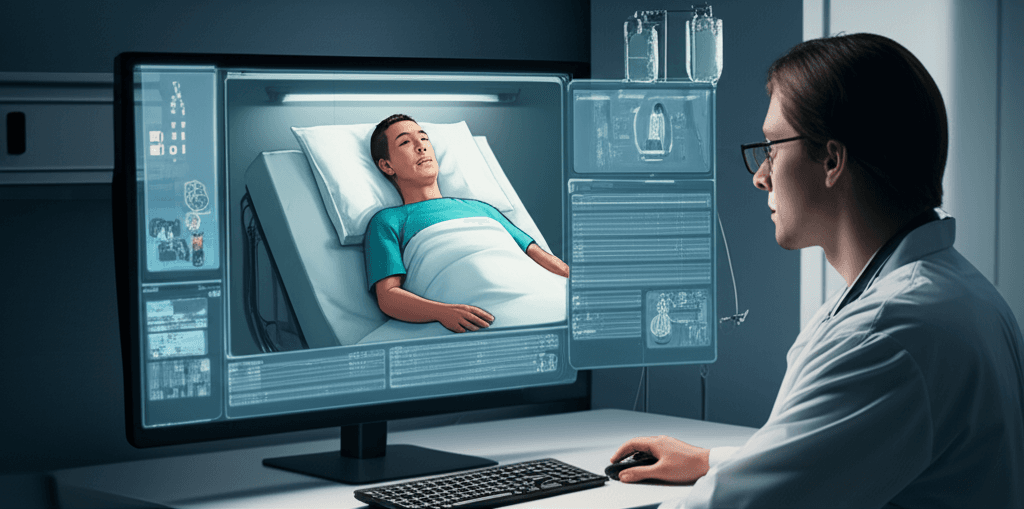
Sharpening Diagnostic Reasoning Through Virtual Patient Practice
Diagnostic error — defined as a diagnosis that is wrong, delayed, or missed — affects an estimated 12 million patients annually in the United States alone. Studies in ambulatory care settings find diagnostic error rates of 5% or higher; in emergency medicine, rates for specific serious conditions approach 20% for atypical presentations. These errors cause patient harm ranging from delayed treatment to permanent disability and death. While system factors contribute to diagnostic error, cognitive factors — the reasoning processes that lead to wrong diagnoses — are primary drivers. Virtual patient simulation provides the most effective available platform for developing the diagnostic reasoning skills that reduce error rates.
The Cognitive Basis of Diagnostic Error
Diagnostic reasoning involves two interacting cognitive systems. System 1 thinking is fast, automatic, and pattern-based: the experienced clinician who recognizes a presentation as consistent with a familiar diagnosis without consciously analyzing it. System 2 thinking is slow, deliberate, and analytical: systematically working through a differential, ordering diagnostic tests to confirm or exclude possibilities, and updating the diagnosis as new information arrives.
Each system is vulnerable to characteristic errors. System 1 is susceptible to pattern recognition failures when presentations are atypical and to cognitive biases such as anchoring (fixing on an early hypothesis and resisting revision), premature closure (stopping the diagnostic search too early), and availability bias (overweighting diagnoses that are cognitively prominent because they were recently encountered). System 2 errors often involve incomplete generation of the differential or failure to update appropriately when new clinical data challenges the working diagnosis.
Designing Scenarios That Target Cognitive Biases
Virtual patient scenarios can be specifically designed to expose specific cognitive biases. An anchoring bias scenario presents a compelling early piece of clinical information that points to a diagnosis, then gradually reveals data that is inconsistent with that diagnosis. Students who anchor on the initial impression fail to revise despite contradicting evidence. The debrief focuses on metacognitive awareness — how did the learner notice or fail to notice that evidence was accumulating against the initial hypothesis?
Premature closure scenarios present a patient who initially seems to have a common, easily treated condition but who actually has a more serious underlying pathology. Students who stop the diagnostic workup after identifying the first plausible explanation miss the more serious diagnosis. These scenarios teach the discipline of generating a complete differential and systematically excluding serious diagnoses before converging on a treatment plan.
Tracking Reasoning Performance Across Cases
One of the most powerful features of virtual patient platforms for diagnostic reasoning development is the ability to track performance across multiple cases and identify patterns in a learner's reasoning. A learner who consistently anchors on initial impressions, consistently fails to consider infectious diagnoses, or consistently rushes to treatment before completing a diagnostic workup will reveal these patterns in their performance data across multiple cases.
Faculty reviewers who can access individual learner performance dashboards can identify diagnostic reasoning patterns that require targeted educational intervention. Rather than waiting for a concerning clinical event to reveal reasoning weaknesses, virtual patient performance data allows proactive identification and remediation of cognitive skills that require development.
The Relationship Between Case Volume and Diagnostic Accuracy
Expert clinical diagnosis depends heavily on pattern recognition built from extensive clinical experience. The 'ten thousand hours' principle applies to clinical diagnosis: diagnostic accuracy improves with the volume of cases encountered and reflected upon. Virtual patient simulation dramatically accelerates the case exposure that would normally require years of clinical practice, allowing learners to build pattern recognition databases much faster than traditional clinical training permits.
Programs that integrate high-volume virtual patient practice across multiple specialties and case types produce graduates with measurably stronger diagnostic reasoning skills than those trained exclusively through traditional clinical rotations. The compounding effect of early, systematic exposure to diverse clinical presentations creates clinical pattern recognition capabilities that benefit patients throughout a clinician's career.