Virtual Reality in Medical Education: Current State and Future
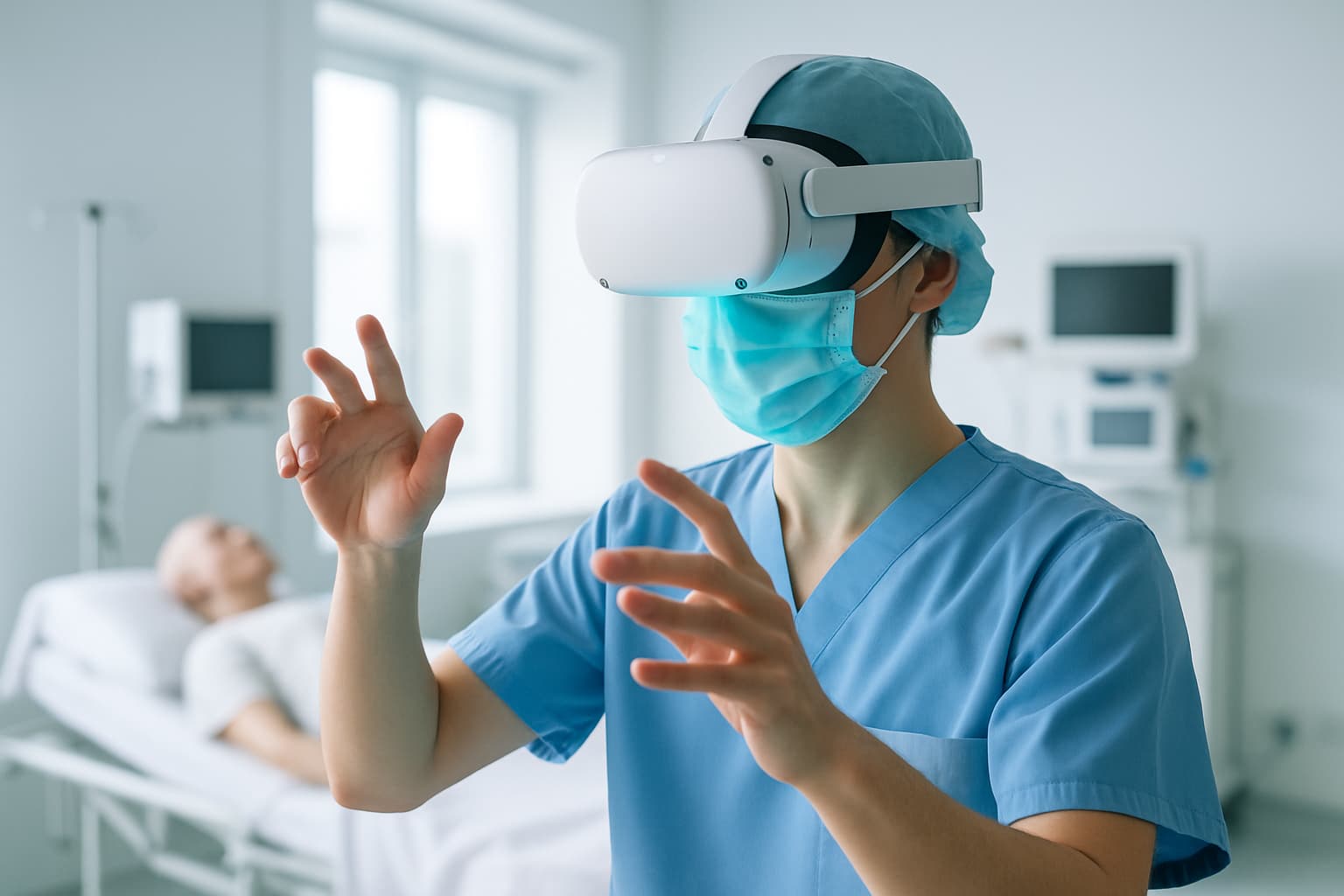
Virtual reality has moved beyond gaming and entertainment into serious professional applications, and medical education is among the most promising domains. VR headsets provide fully immersive three-dimensional environments where students can interact with anatomical structures, practice surgical techniques, and navigate clinical scenarios in ways that flat screens cannot replicate.
Current Applications in Medical Schools
Medical schools worldwide are deploying VR in three primary areas. First, anatomy education: students wear headsets to explore three-dimensional human body models, manipulating organs and systems with hand controllers. This spatial interaction provides an understanding of anatomical relationships that textbook illustrations and even cadaver dissection cannot fully convey.
Second, procedural training: VR environments simulate medical procedures with haptic feedback, allowing students to practice techniques like laparoscopic surgery, endoscopy, or central line insertion in a realistic setting. The immersive nature of VR creates a sense of presence that improves skill transfer to real clinical situations.
Third, clinical scenario simulation: students walk through virtual hospitals, enter patient rooms, conduct interviews, and make treatment decisions. The VR environment adds non-verbal cues, spatial context, and environmental factors that text-based case studies lack.
Hardware Considerations for Institutions
Deploying VR at institutional scale requires thoughtful hardware planning. Standalone headsets have made VR more accessible by eliminating the need for high-end computers and tracking sensors. A university can equip a simulation lab with multiple headsets stored in protective cases with integrated charging stations, making sessions logistically simple.
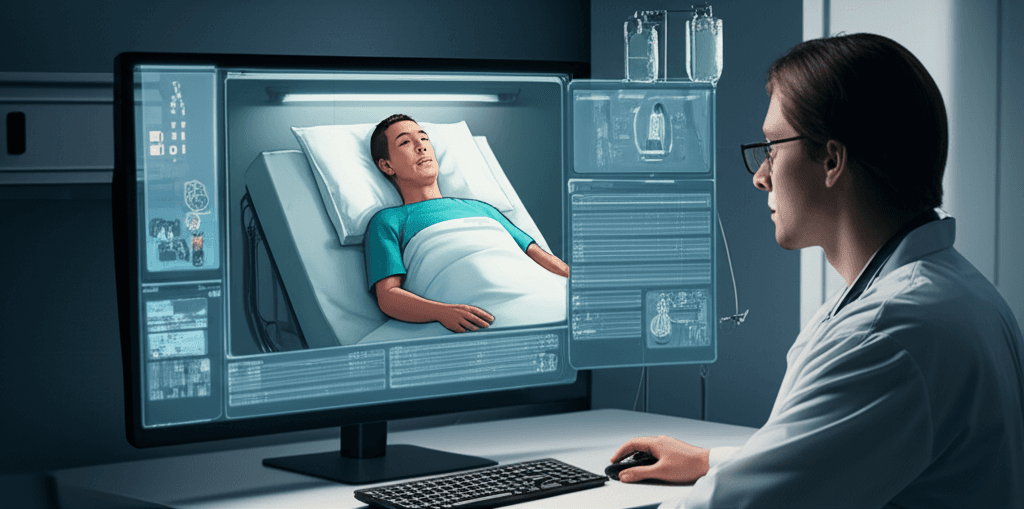
Hybrid solutions combine VR headsets with interactive touchscreen displays, allowing groups of students to observe and discuss what the VR user is experiencing. This approach maximizes the educational value of each VR session by turning individual practice into collaborative learning.
Advantages Over Desktop Simulation
VR adds a dimension of spatial awareness that desktop applications cannot match. When a student holds a virtual organ in their hands and rotates it naturally, the learning experience engages spatial memory pathways that are critical for surgical planning and anatomical understanding. Studies have shown that VR-trained students demonstrate better spatial reasoning on anatomy assessments compared to those trained with desktop-only tools.
The sense of presence in VR also improves engagement and emotional involvement. Students report higher motivation and longer practice sessions when using VR compared to equivalent desktop activities. This increased engagement translates to more deliberate practice hours, which directly correlates with skill development.
Challenges and Limitations
VR is not without limitations. Some students experience motion sickness, particularly during extended sessions. Display resolution, while improving rapidly, still falls short of real-world visual acuity for fine anatomical detail. Hardware costs, though decreasing, remain a consideration for resource-constrained institutions.
The most effective approach treats VR as one component of a broader simulation ecosystem rather than a standalone solution. A comprehensive medical simulation platform should work across modalities: desktop for routine case practice, VR for immersive anatomy and procedural training, and web-based access for theory and self-directed study. This multi-platform approach ensures that educational value is not locked behind a single hardware requirement.
The Near-Term Future
The trajectory of VR in medical education points toward broader adoption as hardware becomes more affordable and software more sophisticated. AI-powered virtual patients that engage in natural conversation through VR interfaces represent the next frontier: students will not just see and manipulate virtual anatomy, but will conduct full clinical encounters in immersive environments that feel increasingly indistinguishable from real hospital settings.
For medical schools evaluating VR today, the key question is not whether to adopt it, but how to integrate it effectively into existing curricula. The institutions that benefit most from VR are those that treat it as a tool for specific learning objectives rather than a technology showcase.