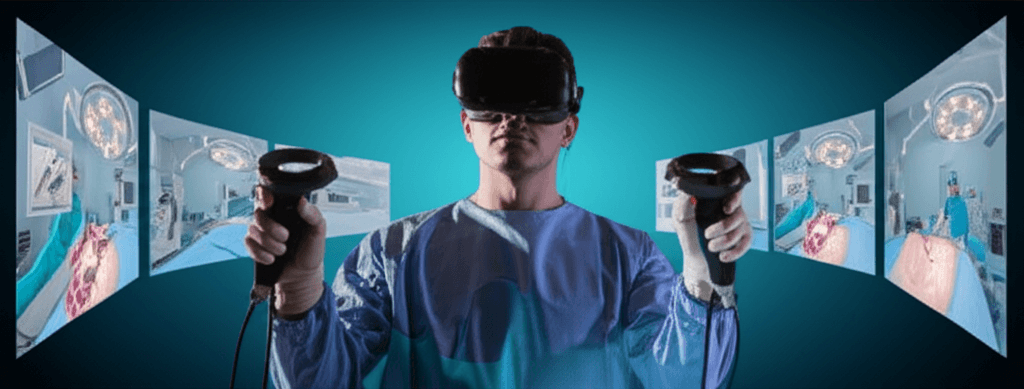
Virtual Reality in Surgical Training: Precision Meets Patient Safety
Virtual reality has transformed from a speculative future for surgical training into a practical present. VR surgical simulators are deployed in residency programs, surgical skills labs, and continuing education programs across specialties including laparoscopic surgery, endoscopy, orthopedics, ophthalmology, vascular surgery, and robotics-assisted procedures. The technical quality of current VR surgical simulators has reached the point where skill transfer from virtual to real surgical environments is well-documented and increasingly well-characterized. Understanding where VR adds genuine training value — and where its limitations require supplementation with other training methods — allows programs to invest in VR strategically.
How VR Surgical Simulation Works
Modern VR surgical simulators combine high-resolution visual rendering, physical instrument interfaces, and haptic feedback systems to create a multisensory surgical environment. The surgeon or trainee holds instrument handles that replicate the weight, grip, and control characteristics of actual surgical instruments. Movement of these handles controls corresponding virtual instruments in the simulated operative field. Advanced haptic systems provide tactile feedback — resistance when cutting through tissue, the distinct feel of different tissue types — that enhances the realism of the simulation and more accurately approximates the physical sensations of actual surgery.
Performance metrics collected by VR systems go far beyond what traditional surgical supervision can provide. Economy of movement, tissue handling quality, procedure time, force applied to structures, identification of critical anatomical landmarks, and complication events are all tracked automatically, providing objective performance data that supplements faculty assessment.
Evidence for VR Surgical Training Effectiveness
The evidence base for VR surgical training is strong and continues to grow. Multiple randomized controlled trials have demonstrated that surgical trainees who achieve defined competency thresholds on VR simulators perform better in actual surgical procedures compared to trainees who received only traditional training. The most cited evidence involves laparoscopic cholecystectomy, where simulation-trained surgeons demonstrated significantly fewer intraoperative errors, faster procedure completion, and lower complication rates in their first clinical procedures.
Transfer of training — the degree to which skills acquired on a simulator improve performance in the real environment — is the critical measure of VR simulator effectiveness. Transfer studies for approved surgical simulators show positive transfer effects ranging from moderate to high, depending on the similarity between simulation and clinical environment and the extent to which the training regimen is structured to optimize transfer.
Haptics and the Limits of Current Technology
While VR surgical simulators have achieved impressive levels of realism, current haptic technology has limitations that affect training fidelity for specific surgical tasks. The precise tactile discrimination required for micro-vascular surgery, the tissue tension recognition important in open surgical dissection, and the palpation skills required for some diagnostic surgical procedures are not fully replicated by current haptic systems. Training programs using VR must recognize these limitations and supplement with bench trainers or cadaveric models where haptic precision is the primary learning objective.
The field of haptic technology continues to advance rapidly. New approaches including multi-point haptic feedback, deformable tissue models with accurate physical properties, and tactile gloves that provide finger-level texture sensation are in active development. As these technologies mature, the haptic fidelity of VR surgical simulation will continue to improve, progressively closing the gap between virtual and real surgical experience.
Integration with Robotic Surgical Training
Robotic surgery, led by the Da Vinci Surgical System and expanding to newer platforms, has created both demand and opportunity for simulation-based training. The robotic console interface introduces a new set of technical skills distinct from conventional laparoscopic surgery, and surgeons transitioning to robotic practice require systematic practice in robotic instrument control, camera management, and three-dimensional visualization. The Da Vinci Surgical System simulator, integrated directly into the surgical console, provides procedure-specific simulation with detailed performance metrics that track surgical development.
Structured robotic simulation curricula, like those developed by the Society of American Gastrointestinal and Endoscopic Surgeons (SAGES), provide a standardized pathway for robotic surgical training that combines simulation practice with supervised clinical progression. Programs that implement these structured curricula produce robotically trained surgeons more efficiently than unstructured mentorship models.