Building a Simulation Center: What Medical Schools Need to Know
The decision to build or expand a medical simulation center is among the most consequential investments a medical school makes. Done well, a simulation center transforms clinical education, improves student outcomes, and becomes a competitive differentiator for the institution. Done poorly, it becomes an expensive room with underused equipment. This guide addresses the key decisions that determine which outcome results.
Defining the Educational Objectives First
The most common mistake in simulation center planning is starting with technology rather than educational goals. Before selecting equipment, the institution must clearly define what clinical competencies the center will develop, which courses and rotations will use the center, how many students will cycle through each year, and what assessment methods the center will support.
These educational objectives drive every subsequent decision: room layout, technology selection, staffing requirements, and budget allocation. A center focused primarily on procedural skills training will look very different from one focused on clinical reasoning and virtual patient interaction.
Technology Selection: Software vs Hardware
Simulation technology falls into two broad categories. Hardware-based simulation includes physical manikins, task trainers, and standardized patient actors. Software-based simulation includes virtual patient platforms, 3D anatomy applications, and VR environments. Most effective centers combine both approaches.
Software-based simulation offers significant advantages in scalability and cost per student hour. A single software platform can serve hundreds of students across all specialties simultaneously, while a physical manikin occupies one room and serves one group at a time. For institutions with large student bodies or limited physical space, software-first approaches deliver more educational hours per dollar invested.
Hardware adds physical fidelity: the ability to practice hands-on procedures, develop tactile skills, and work with physical equipment. Purpose-built simulation furniture, such as interactive table-panel hybrids with integrated displays and VR headsets, combines software capabilities with a physical presence that anchors the center.
Space and Layout Considerations
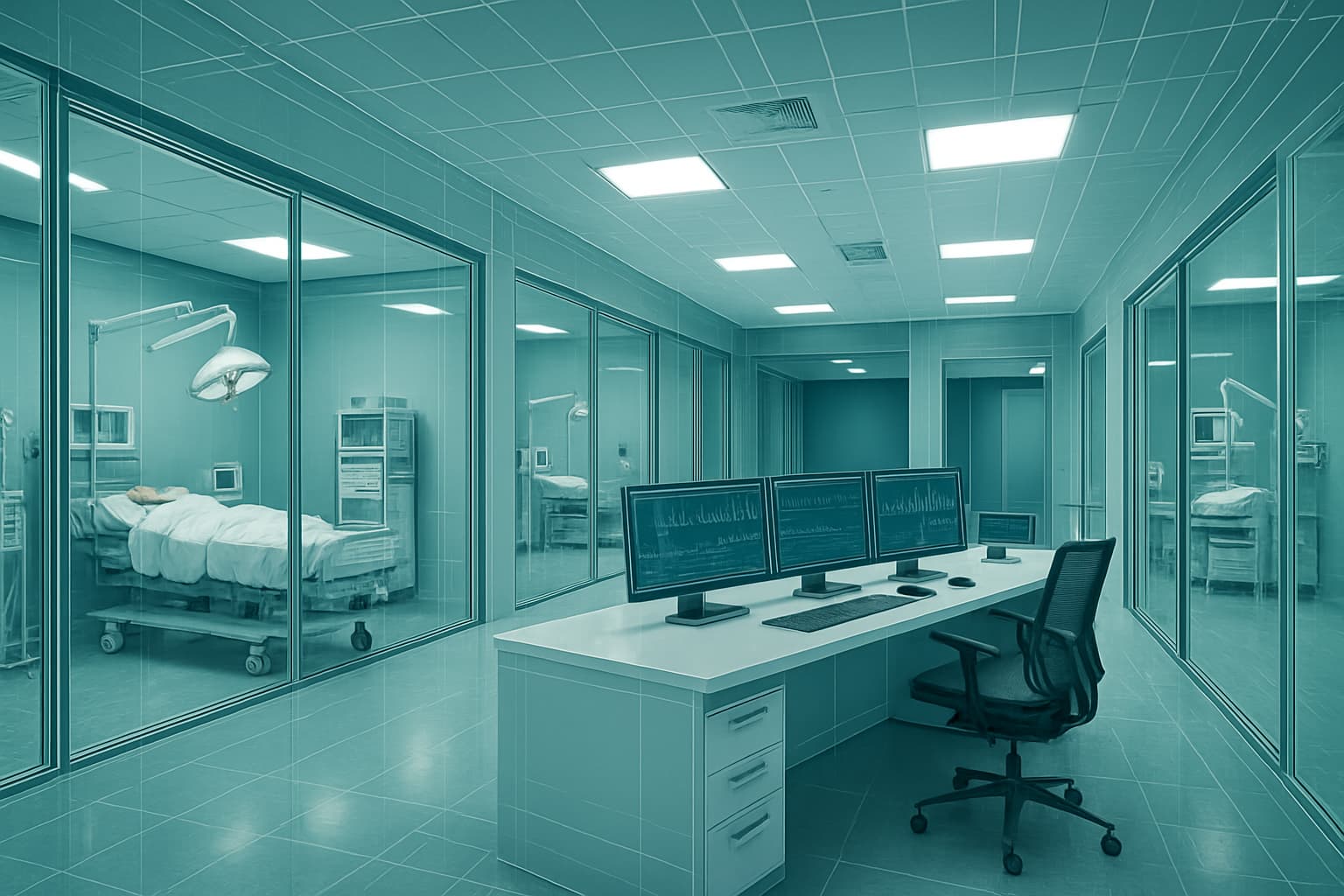
A simulation center needs more than simulation rooms. Support spaces include debriefing rooms where students review performance after scenarios, control rooms for managing simulated patient responses, storage for equipment and consumables, and a reception or orientation area. The ratio of simulation space to support space is typically sixty-forty.
Flexibility is critical. Rooms should be configurable for different types of simulation: individual virtual patient practice, group clinical scenarios, procedural skills workshops, and large-group debriefings. Modular furniture, movable partitions, and flexible AV systems support this adaptability.
Staffing the Center
Technology alone does not create educational value. Simulation centers require trained facilitators who can design scenarios, guide debriefings, and maintain equipment. The minimum viable team for a mid-sized center includes a medical director (typically a faculty member with simulation expertise), a simulation technologist, and an operations coordinator.
Faculty development is equally important. Clinical faculty who will use the center need training in simulation pedagogy, debriefing techniques, and the specific technology the center deploys. Institutions that invest in faculty development consistently see higher utilization rates and better educational outcomes from their simulation centers.
Budget Planning
Simulation center budgets encompass four categories: initial capital expenditure (construction, equipment purchase), ongoing technology costs (software licenses, equipment maintenance), personnel costs (staff salaries, faculty time), and consumables (task trainer supplies, standardized patient fees).
For a software-centric center, the cost structure shifts heavily toward annual licensing and personnel, with lower capital requirements compared to hardware-heavy centers. A university deploying a comprehensive virtual patient platform with VR hardware might budget in the range of twenty to fifty thousand dollars for technology and equipment in the first year, with ongoing annual costs for software licensing and maintenance.
Measuring Return on Investment
Accreditation bodies increasingly require evidence of simulation-based training. A well-documented simulation program strengthens accreditation applications and can differentiate the institution in competitive recruitment. Beyond accreditation, measurable outcomes include student performance improvements on clinical assessments, reduction in remediation rates, and student satisfaction scores.
For the investment calculation, compare simulation center costs to the alternatives: expanding clinical rotation capacity (more preceptors, more sites), hiring additional standardized patients, or accepting lower student preparation levels. When framed against these alternatives, simulation investment often represents the most cost-effective path to improved clinical education.