How AI Is Transforming Medical Student Assessment
Traditional medical student assessment relies heavily on written examinations and periodic clinical evaluations. A student might take an anatomy exam, a pharmacology exam, and an OSCE (Objective Structured Clinical Examination) at specific checkpoints throughout their training. These assessments provide snapshots of knowledge at particular moments but miss the continuous development of clinical reasoning that occurs between exams.
From Snapshots to Continuous Evaluation
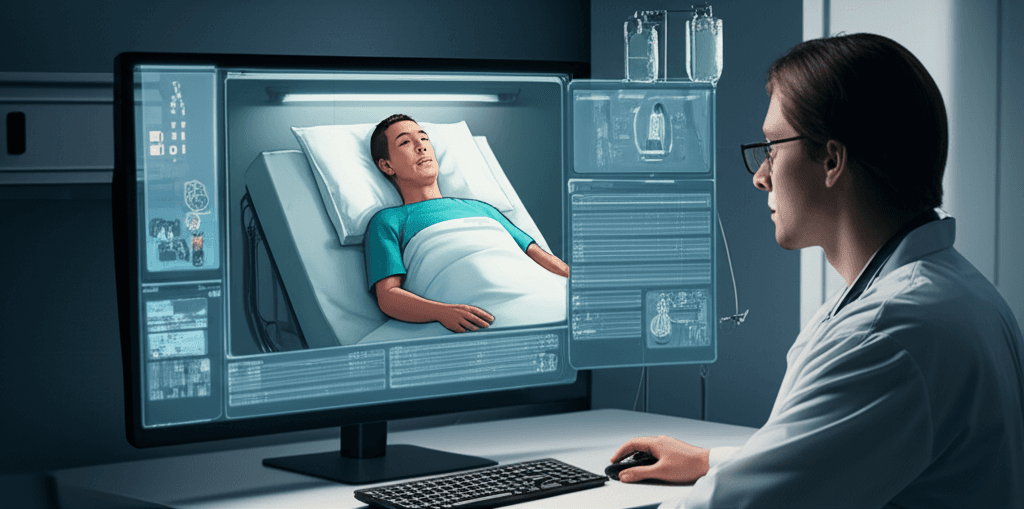
AI-powered simulation platforms can track every decision a student makes during virtual clinical encounters. When a student interviews a virtual patient, the AI records which questions they ask, in what order, how they interpret the responses, what differential diagnoses they consider, which tests they order, and how they modify their assessment as new information becomes available.
This granular tracking creates a comprehensive picture of clinical reasoning development over time. Faculty can see not just whether a student reached the correct diagnosis, but how efficiently they got there, whether they considered appropriate alternatives, and whether their reasoning process was systematic or haphazard.
AI-Powered Virtual Patients
The most significant advancement in AI-based assessment is the virtual patient powered by large language models. Unlike scripted case scenarios with predetermined branching paths, AI virtual patients engage in natural conversation. They respond to open-ended questions, provide nuanced symptom descriptions, and react realistically to the student's clinical approach.
This means students cannot game the system by memorizing correct answer paths. Every interaction is unique, and the AI evaluates clinical reasoning quality rather than answer matching. A student who asks the right questions for the wrong reasons will be scored differently from one who demonstrates sound clinical logic, even if both arrive at the same diagnosis.
Identifying Knowledge Gaps at Scale
When hundreds of students interact with the same AI virtual patient scenarios, aggregate data reveals patterns that individual assessments cannot. If seventy percent of third-year students consistently fail to consider endocrine causes for a presenting complaint, that signals a curriculum gap in endocrinology education. If students from one clinical rotation site perform significantly differently from another, that reveals variation in clinical teaching quality.
This data-driven approach to curriculum improvement is only possible when assessment is continuous, standardized, and comprehensive. AI simulation platforms generate this data as a natural byproduct of student practice, requiring no additional testing time or faculty effort.
Objective Scoring Without Examiner Bias
Human clinical examiners, despite training and calibration, introduce variability into assessments. Studies have documented significant inter-examiner variation in OSCE scoring, where the same student performance receives different scores from different examiners. AI-based assessment eliminates this variability by applying consistent evaluation criteria to every student interaction.
This objectivity is particularly valuable in high-stakes assessments where fairness is paramount. When competency decisions affect a student's progression through medical school, the assessment method must be demonstrably consistent and unbiased.
Practical Implementation
For medical schools, AI-powered assessment complements rather than replaces traditional methods. Written exams remain effective for testing factual recall. OSCEs remain valuable for assessing physical examination skills and bedside manner. AI simulation adds the ability to assess clinical reasoning depth and consistency at a scale and frequency that human-assessed methods cannot match.
The ideal assessment strategy combines all three approaches: knowledge exams for facts, OSCEs for hands-on skills, and AI simulation for clinical reasoning. Together, they provide a comprehensive view of each student's readiness for clinical practice.