How AI Is Changing Virtual Patient Interactions in 2026
Virtual patient simulation began as branching decision trees: the student selects an option, the system follows a predetermined path based on that selection. This approach works but feels mechanical. Real patients do not present symptoms from a menu of options. They describe complaints in their own words, respond to follow-up questions with varying levels of detail, and exhibit emotional states that affect the clinical interaction.
Artificial intelligence is closing the gap between scripted simulation and authentic clinical interaction. Natural language processing, adaptive algorithms, and machine learning are transforming virtual patients from interactive flowcharts into responsive clinical entities that behave more like real patients. For medical education, this transformation has significant implications for how clinical skills are taught, practiced, and assessed.
This article examines the specific AI capabilities that are reshaping virtual patient simulation today, distinguishing between demonstrated capabilities and marketing promises. For academic administrators evaluating simulation platform investments, understanding the current state and near-term trajectory of AI in medical simulation is essential for making procurement decisions that will remain relevant as the technology continues to advance.
Natural Language Processing and Patient Communication
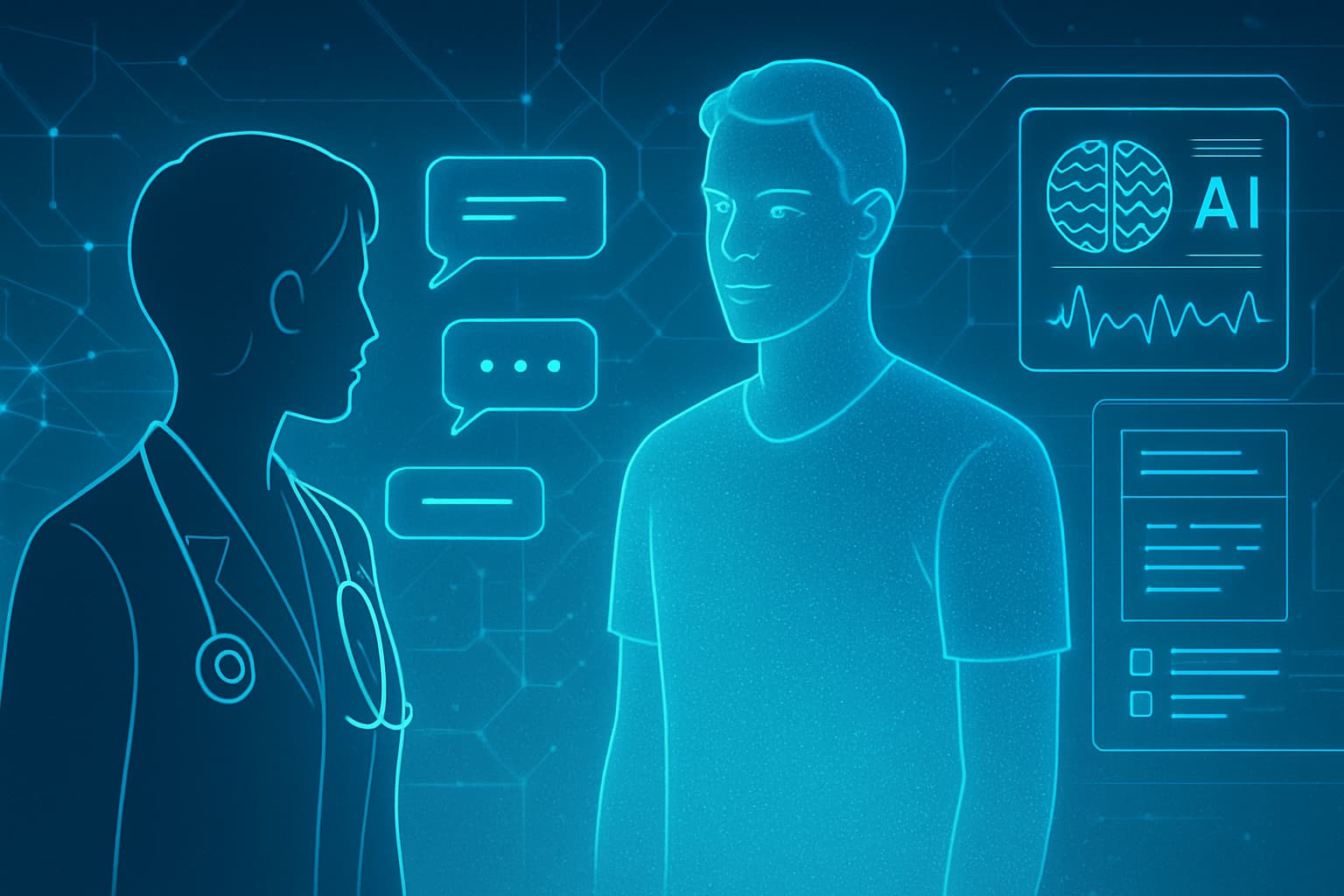
The most visible AI advancement in virtual patient simulation is natural language interaction. Instead of selecting from predefined questions, students can ask questions in natural language, and the virtual patient responds conversationally. This fundamentally changes the learning experience from a structured exercise into a realistic clinical encounter.
Modern language models can generate clinically appropriate patient responses that include the variability and imprecision of real patient communication. A virtual patient with chest pain might describe it as a tightness, a burning sensation, or a weight on the chest depending on their character profile. They might forget to mention a relevant medication, give vague timelines, or express anxiety that affects their ability to communicate clearly. These natural variations force students to develop the same communication and information-gathering skills they need with real patients.
The challenge with natural language interaction is maintaining clinical accuracy. The language model must generate responses that are consistent with the underlying medical condition, the patient's history, and previous statements in the conversation. Advances in retrieval-augmented generation and domain-specific model fine-tuning have improved accuracy significantly, but institutions should evaluate the clinical fidelity of AI-generated patient responses before relying on them for assessment purposes.
Adaptive Difficulty and Personalized Learning
Traditional virtual patient cases present the same level of difficulty to every student regardless of their competency level. A first-year student and a fourth-year student encounter identical symptoms, identical test results, and identical clinical complexity. AI enables adaptive systems that adjust difficulty based on demonstrated student capability.
An adaptive virtual patient might present a straightforward case to a student who is struggling with basic clinical reasoning, then gradually introduce complications, atypical presentations, and diagnostic challenges as the student demonstrates proficiency. This personalization ensures that every student is challenged at the appropriate level, maximizing learning efficiency for both beginners and advanced students.
Adaptive systems also personalize the sequence of cases presented. If a student consistently struggles with cardiovascular cases but excels in pulmonology, the system can increase the proportion of cardiovascular cases in their practice schedule while maintaining exposure to other specialties. This targeted practice addresses individual weaknesses more efficiently than a one-size-fits-all curriculum.
Automated Assessment and Feedback
AI-powered assessment is perhaps the most practically significant advancement for medical education institutions. Traditional assessment of clinical reasoning requires expert evaluators who review student decisions, which is expensive and difficult to scale. AI systems can evaluate student clinical reasoning in real time, providing immediate feedback that was previously available only during supervised clinical encounters.
These systems analyze not just whether the student reached the correct diagnosis but how they got there. Did they take a systematic history or jump to conclusions? Did they order appropriate investigations or unnecessary tests? Did they consider dangerous diagnoses that needed to be ruled out? This process evaluation provides richer feedback than outcome-only assessment.
Automated feedback also enables deliberate practice at a scale that human evaluation cannot match. A student can work through dozens of cases with detailed AI-generated feedback in the time it takes to schedule a single faculty evaluation session. This volume of practice with feedback accelerates clinical reasoning development significantly.
The quality of AI-generated feedback is approaching parity with expert human evaluators for many assessment dimensions. Studies comparing AI assessment of clinical reasoning with faculty assessment show strong correlation for standardized scenarios, particularly in areas like history-taking completeness, diagnostic test appropriateness, and treatment plan rationality. Where AI assessment currently falls short is in evaluating the nuance of clinical communication, empathy, and professional behavior, domains where human judgment remains essential.
AI-Generated Clinical Cases
Creating high-quality clinical cases is time-consuming and requires significant clinical expertise. AI is beginning to assist in case authoring, generating clinically plausible patient scenarios based on defined parameters: specialty, complexity level, target competencies, and disease prevalence data.
AI-generated cases can fill gaps in existing case libraries, particularly for rare conditions that are difficult to author manually. They can also create case variations that present the same underlying condition with different patient demographics, histories, and presenting symptoms. This variation prevents students from pattern-matching based on surface features rather than engaging in genuine clinical reasoning.
Faculty review of AI-generated cases remains essential. Clinical accuracy, educational appropriateness, and alignment with learning objectives must be verified by subject matter experts before cases are used with students. AI case generation is best understood as an authoring aid that accelerates case development rather than a replacement for clinical editorial oversight.
Predictive Analytics for Student Performance
AI systems can identify students who are likely to struggle in clinical rotations based on their simulation performance patterns, potentially months before the difficulties become apparent in clinical settings. These predictive models analyze patterns in clinical decision-making, response times, error types, and learning trajectories to flag students who may benefit from additional support.
Early identification of at-risk students enables proactive intervention: additional simulation practice, targeted tutoring, or modified rotation schedules that provide more supervised experience. This preventive approach is more effective and less stigmatizing than remediation after clinical failures.
The ethical considerations of predictive analytics in medical education are significant and must be addressed explicitly. Students should understand what data is collected and how it is used. Predictive flags should trigger supportive interventions, not punitive actions. The algorithms should be transparent enough for faculty to understand and validate their recommendations.
The Near-Term Future of AI in Medical Simulation
The pace of AI advancement suggests that virtual patient interactions will continue to become more realistic, more personalized, and more educationally effective. Within the next few years, we can expect virtual patients that maintain consistent personalities across multiple encounters, remember previous interactions with a student, and evolve their conditions over time in response to treatment decisions.
Multimodal AI will enable virtual patients that exhibit visible symptoms, respond to physical examination with appropriate findings, and display emotional responses that students must recognize and address. These capabilities will further close the gap between virtual and real patient encounters, extending the range of clinical skills that can be effectively taught through simulation.
For medical education administrators, the practical implication is that virtual patient platforms should be evaluated not only on current capabilities but on the vendor's AI development trajectory. The platforms that are integrating AI most aggressively today will likely deliver the most significant educational improvements over the next several years. Investing in a platform with a strong AI roadmap is investing in the future of clinical education at your institution.
Institutional Readiness for AI-Enhanced Simulation
Adopting AI-enhanced simulation requires institutional readiness beyond purchasing a software license. Faculty need to understand what AI capabilities are available and how to incorporate them into their teaching. IT infrastructure must support the computational demands of real-time AI processing. Assessment policies must be updated to account for AI-generated feedback and its role in student evaluation. Privacy and data governance frameworks must address the collection and use of detailed behavioral data that AI systems generate.
Start with a readiness assessment that evaluates your institution's current state across these dimensions. Identify gaps between current capabilities and the requirements of AI-enhanced simulation. Develop a roadmap that addresses the most critical gaps first: faculty awareness, data governance policies, and basic technical infrastructure. More advanced capabilities like AI-driven personalization and predictive analytics can follow once the foundation is solid.
Engage with vendors who can demonstrate real AI capabilities in their platforms, not just marketing promises. Ask for evidence of educational outcomes from institutions that are already using AI features. Request access to pilot programs that allow your faculty to experience AI-enhanced simulation before committing to a full institutional deployment. The institutions that begin building AI readiness today will be best positioned to leverage these capabilities as they mature over the coming years.