Nursing Simulation: Building Clinical Competency Before the Bedside
Nursing education programs have long struggled with the theory-practice gap — the disconnect between what students learn in the classroom and what they encounter on the clinical floor. Simulation offers a structured bridge between these two worlds. Rather than placing unprepared students in high-stakes clinical situations, simulation allows nursing programs to develop competency in a controlled environment where mistakes become learning opportunities rather than patient safety events.
The Case for Simulation in Nursing Programs
Clinical placement shortages in many regions have made nursing simulation not just educationally valuable but practically necessary. With insufficient clinical hours available to all nursing students, simulation supplements live clinical experience. In some jurisdictions, regulatory bodies now formally recognize simulation hours as equivalent to clinical placement hours, reflecting growing evidence that simulation-based learning produces nurses who perform at least as well in practice as those trained exclusively through traditional clinical rotations.
Beyond access, simulation provides exposure to rare but critical events. Anaphylactic reactions, cardiac arrest, neonatal resuscitation, and rapidly deteriorating sepsis are scenarios every nurse must be able to manage, yet most students will never encounter these events in clinical placement. Simulation ensures universal exposure regardless of the luck of clinical scheduling.
Technical and Non-Technical Skill Development
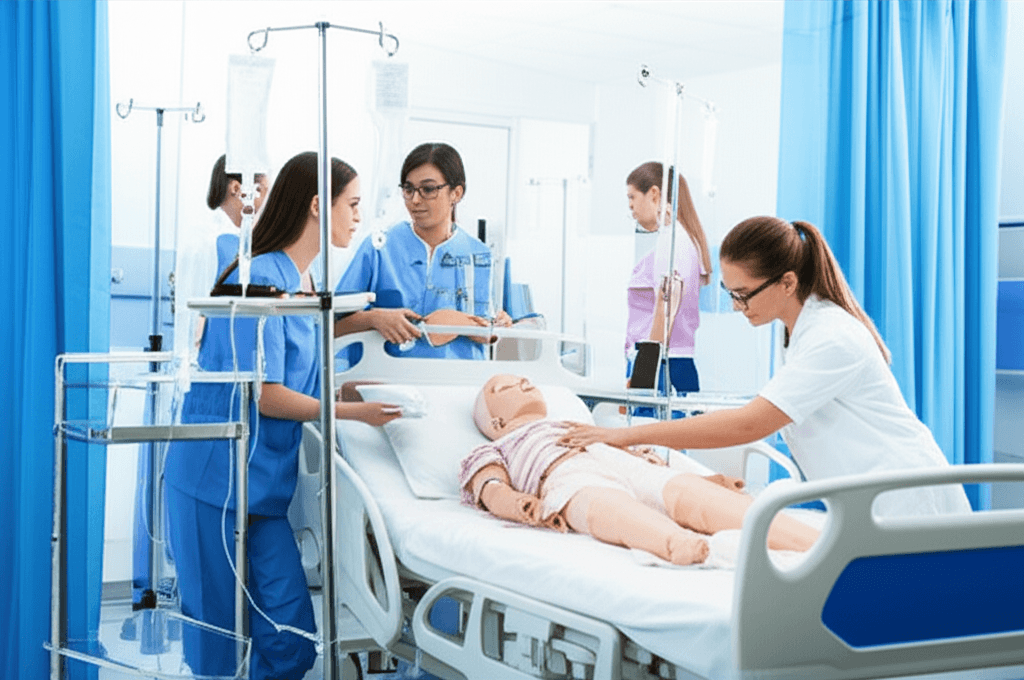
Nursing simulation addresses two distinct skill sets. Technical skills include IV catheter insertion, medication administration, wound management, patient assessment, and the operation of monitoring equipment. Simulation labs provide task trainers and mannequins that allow students to practice these skills repeatedly until they achieve competency without placing real patients at risk.
Non-technical skills are equally important and often more difficult to teach in traditional educational settings. Situation awareness, clinical handover communication, patient advocacy, and escalation of deteriorating patients all require social and cognitive skills that develop through practice in realistic interpersonal scenarios. Simulation creates authentic interactions — with a deteriorating patient, a distracted physician who dismisses nursing concerns, or a family member demanding information — where students develop professional confidence alongside clinical skill.
The SBAR Framework and Communication Simulation
Communication failures are implicated in a substantial proportion of adverse patient safety events. The SBAR framework (Situation, Background, Assessment, Recommendation) provides a structured template for clinical communication between nurses and physicians, but its effective use requires practice. Simulation scenarios specifically designed around clinical communication allow students to practice SBAR handovers, escalate patient concerns to reluctant physicians, and navigate the hierarchical dynamics of healthcare teams.
Role-playing scenarios involving family communication develop a different but equally essential set of skills. Delivering difficult news, explaining clinical situations in accessible language, and managing distressed relatives are challenges that prepare nurses for one of the most human dimensions of their work.
Assessment and Competency Verification
Objective structured clinical examinations (OSCEs) in nursing programs commonly use simulation stations to assess clinical competency. Assessors use validated checklists to score performance on specific skills, ensuring that every student demonstrates minimum competency standards before clinical placement. This standardized approach is more rigorous than traditional direct observation, which varies substantially in quality and consistency across clinical settings.
Competency verification through simulation also benefits clinical employers. Graduates who can demonstrate simulation-verified competencies in core nursing skills present less orientation burden to healthcare facilities and can be trusted with increasing clinical responsibility more quickly. Some healthcare systems have begun partnering with nursing schools to align simulation curricula directly with the competency frameworks used for newly hired nurses, creating a seamless transition from education to practice.