How to Set Up a Medical Simulation Center on a Limited Budget
Not every medical school has the budget for a state-of-the-art simulation center filled with high-fidelity mannequins, dedicated VR labs, and purpose-built clinical environments. Yet the educational evidence for simulation-based learning is strong enough that even resource-constrained institutions cannot afford to ignore it entirely. The challenge is building meaningful simulation capabilities within realistic budget constraints.
The good news is that modern virtual patient platforms have fundamentally changed the economics of medical simulation. A decade ago, simulation required significant physical infrastructure. Today, a well-chosen software platform can deliver substantial clinical reasoning practice with minimal hardware investment. The key is starting with the right priorities and scaling intelligently.
This guide provides a practical roadmap for institutions that need to build simulation capabilities without the luxury of a large capital budget. The strategies outlined here draw on experiences from medical schools across diverse economic contexts, from small private institutions in emerging markets to public universities in established systems facing persistent funding constraints. The underlying principles are universal because the challenge is shared: delivering maximum educational value within financial reality.
Start with Software, Not Hardware
The most common mistake in simulation center planning is starting with physical equipment. Mannequins, task trainers, and VR headsets are tangible and impressive in budget presentations, but they are expensive to purchase, maintain, and staff. More importantly, they serve a relatively narrow range of learning objectives.
Virtual patient software platforms can deliver clinical reasoning, diagnostic skills, and treatment planning practice to every student on their personal laptop or existing institutional computers. There is no scheduling bottleneck, no maintenance cost per session, and no dedicated physical space required. A medical school that invests in a comprehensive virtual patient platform before purchasing any physical equipment will deliver more total simulation hours per dollar than one that builds a traditional simulation center first.
This does not mean physical simulation equipment has no value. It means the optimal sequence is to establish a software foundation first, prove educational outcomes, and then selectively add physical equipment for skills that specifically require hands-on practice, such as procedural technique and physical examination.
Phased Implementation: The Three-Tier Approach
A phased approach reduces financial risk and allows the institution to learn from each stage before committing additional resources. The three tiers can be implemented over two to four years depending on budget availability and institutional priorities.
Tier one focuses on virtual patient software and existing infrastructure. Select a platform with broad specialty coverage and evidence-based clinical scenarios. Deploy it on existing computers and student devices. Train a small group of faculty champions who will integrate the platform into their courses. Total investment at this tier is primarily the software license fee plus faculty development time. This tier alone can transform clinical reasoning education.
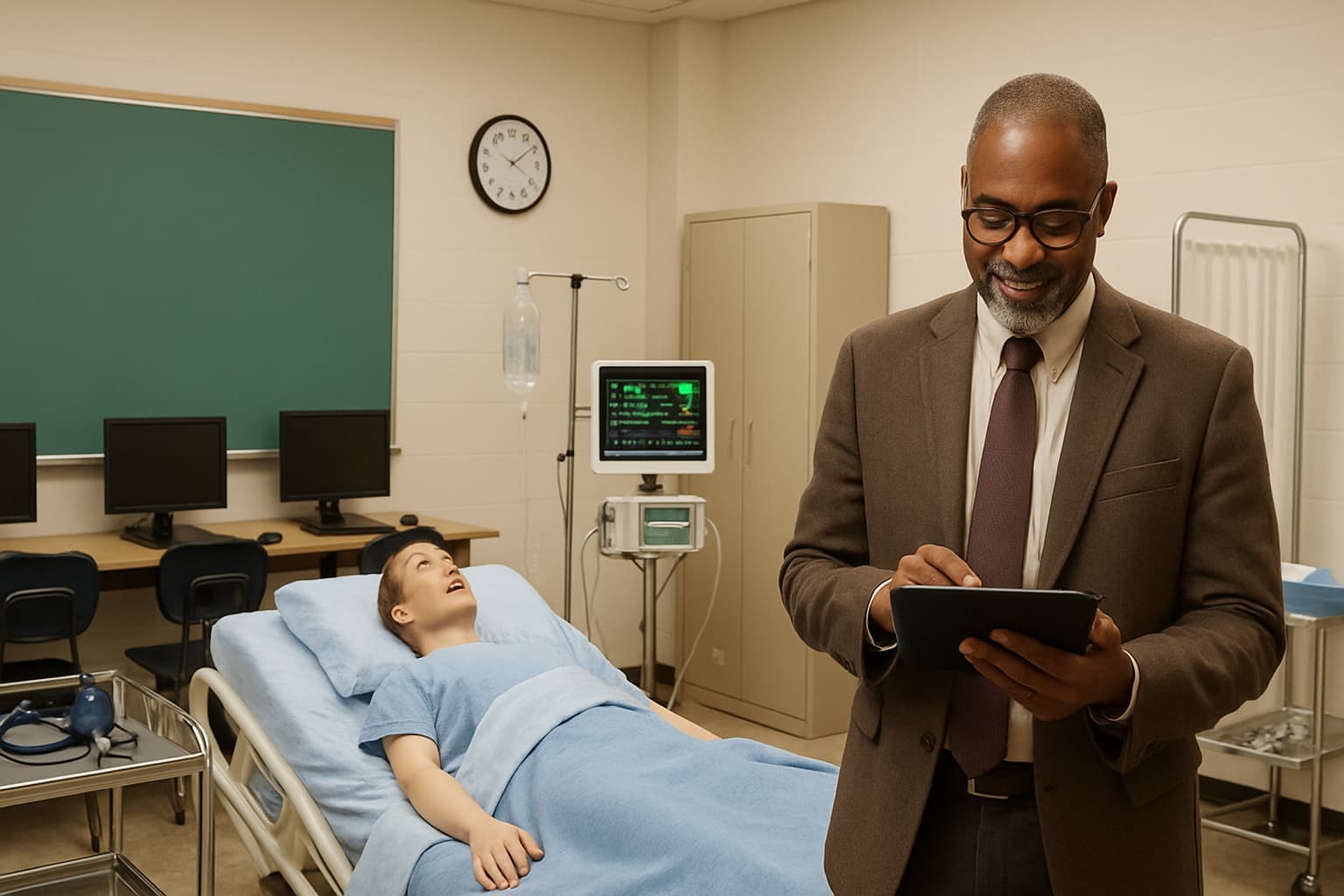
Tier two adds a dedicated simulation space. This does not need to be a purpose-built facility. A repurposed classroom with appropriate furniture, basic audiovisual equipment, and reliable internet connectivity is sufficient. Add a small number of task trainers for procedural skills that genuinely require physical practice: suturing, IV insertion, catheterization, and basic examination techniques. Avoid the temptation to purchase expensive high-fidelity mannequins at this stage.
Tier three introduces advanced capabilities based on demonstrated need. This might include high-fidelity mannequins for specific scenarios, VR equipment for immersive training, or dedicated hardware solutions like interactive touchscreen panels. By this stage, the institution has data on which simulation modalities deliver the most educational value for their specific curriculum, making investment decisions evidence-based rather than aspirational.
Space Requirements: Less Than You Think
Traditional simulation center design assumes dedicated clinical environments: mock exam rooms, operating theaters, and emergency departments built to resemble real clinical spaces. This approach requires significant square footage and construction budget. For institutions with limited resources, a more practical approach is a flexible multipurpose space.
A single large room with movable partitions, basic medical furniture, and reliable power and network infrastructure can serve as an exam room, consultation space, or procedure room depending on the session. When combined with virtual patient software that provides the clinical context on screen, the physical environment needs to suggest a clinical setting rather than replicate one precisely. Students who are immersed in a compelling virtual case care less about the physical fidelity of the room than the educational quality of the scenario.
Many institutions have successfully repurposed conference rooms, unused lecture halls, or library spaces as simulation areas with minimal renovation. The critical requirements are privacy for individual or small-group sessions, reliable internet for software-based simulation, and basic audiovisual capability for debriefing.
Consider also the power of portable simulation. A cart with several laptops loaded with virtual patient software, a basic anatomical model, and a task trainer for procedural practice can be wheeled into any available room and set up in minutes. This mobile simulation approach eliminates the need for dedicated space entirely during the early stages of program development, allowing the institution to demonstrate value before committing to permanent infrastructure investment.
Staffing a Simulation Program Efficiently
Staffing costs are the largest recurring expense in any simulation program and the area where creative approaches can yield the most savings. A traditional simulation center requires simulation technicians, standardized patient actors, and dedicated simulation faculty. Each of these roles is expensive.
Virtual patient platforms dramatically reduce staffing needs for clinical reasoning education. The software replaces standardized patient actors for diagnostic scenarios, eliminates the need for simulation technicians to set up and reset physical equipment, and provides automated feedback that supplements faculty assessment. One faculty member supervising a computer lab of twenty students using virtual patients can deliver more clinical reasoning practice hours than the same faculty member running individual standardized patient encounters.
For procedural skills that do require physical practice and supervision, consider a peer teaching model where senior students, supervised by faculty, teach procedural techniques to junior students. This approach develops teaching skills in senior students while reducing the faculty hours required per student trained.
Measuring Impact to Justify Continued Investment
Limited-budget programs face constant pressure to justify their existence and funding. Building measurement into the program from day one is essential for survival. Track simulation hours per student per semester, student performance on clinical assessments before and after simulation integration, student satisfaction with simulation experiences, and faculty adoption rates.
Compare these metrics against the institutional cost per simulation hour. If your virtual patient platform costs fifty thousand dollars per year and delivers ten thousand student simulation hours, your cost is five dollars per simulation hour. Compare this against the cost of a standardized patient encounter, which typically ranges from fifty to two hundred dollars per student per session. These numbers make a compelling case for continued and expanded investment.
Document specific instances where simulation training visibly improved student performance in clinical rotations. Faculty observations, clinical supervisor feedback, and student self-reports all contribute to a narrative of educational impact that supports budget requests.
Common Mistakes to Avoid
Buying equipment before defining educational goals leads to expensive equipment sitting unused because it does not align with curriculum needs. Define learning objectives first, then select the tools that address those objectives most cost-effectively.
Underestimating faculty development is the second most common mistake. Even the best simulation platform delivers no value if faculty do not integrate it into their teaching. Budget for faculty training time, compensate early adopters for their additional effort, and celebrate integration successes publicly.
Trying to replicate a well-funded simulation center on a limited budget guarantees disappointment. Instead, define what a simulation program looks like at your budget level, optimize within those constraints, and plan a realistic growth trajectory. A focused, well-executed program that delivers clear educational outcomes on a modest budget is more valuable than an ambitious program that overspends and underdelivers.
Funding Sources and Grant Opportunities
Many institutions overlook available funding sources that can subsidize simulation program development. Government health workforce development grants, international development organization funding, and educational technology innovation awards all represent potential revenue streams. National ministries of health in many countries have allocated funds specifically for modernizing medical education, and simulation programs align directly with these priorities.
Vendor-sponsored pilot programs offer another funding pathway. Many simulation platform companies provide discounted or trial licenses to institutions that agree to share outcome data and serve as reference sites. These arrangements benefit both parties: the institution gets access to technology at reduced cost, and the vendor gets implementation data and a potential case study. Do not hesitate to negotiate with vendors, especially if your institution represents a market segment they want to enter.
Collaborative purchasing consortia, where multiple institutions in a region negotiate a joint license at volume discount, can reduce per-institution costs significantly. If your institution is part of a university system or a national medical education network, explore whether coordinated procurement is possible. The savings from volume licensing can make the difference between an affordable and an unaffordable program.