Continuing Medical Education in the Simulation Era: Keeping Skills Sharp
Continuing medical education (CME) is a regulatory requirement for maintained medical licensure in most jurisdictions, yet decades of research have consistently found that traditional CME formats — conferences, lectures, online modules — produce minimal changes in clinical behavior. Clinicians can complete required CME hours while learning very little that changes how they practice. Simulation-based CME represents a fundamentally different approach: active, practice-based learning that targets specific clinical competencies and has documented effects on clinical performance.
Why Traditional CME Falls Short
Passive educational formats — attending lectures, watching presentations, reading journals — activate knowledge acquisition pathways but rarely produce the behavioral changes that improve patient outcomes. The gap between knowledge and performance is well-established in educational psychology: knowing what one should do and reliably doing it in practice are different capacities that require different types of development. Simulation targets performance directly.
Traditional CME also suffers from the problem of skill decay. Clinical skills that are learned but infrequently practiced deteriorate over time. A physician who manages a specific emergency rarely may know the protocol but may not be able to execute it fluently under pressure when it matters. Simulation-based refresher training directly addresses skill decay by reestablishing fluency through practice.
Competency Verification Through Simulation
An increasing number of credentialing bodies and healthcare organizations are moving toward competency-based credentialing that requires demonstrated performance rather than credit hour accumulation. Advanced cardiac life support (ACLS), pediatric advanced life support (PALS), neonatal resuscitation, and advanced trauma life support (ATLS) already require simulation-based skill assessment for certification. This model is expanding to include procedural competency verification across a growing range of clinical domains.
Healthcare organizations that credential clinicians for specific procedures increasingly require simulation-based competency verification as part of the credentialing process. This creates institutional demand for simulation infrastructure and positions simulation as a business-critical capability for healthcare facilities rather than a purely educational investment.
Designing Effective Simulation-Based CME
Simulation-based CME that changes clinical practice shares common design features. It targets specific, measurable competencies rather than broad knowledge domains. It provides practice with feedback rather than just information delivery. It includes spaced repetition — multiple short practice sessions over time — rather than massed practice in a single session. And it addresses the cognitive, technical, and interpersonal dimensions of clinical performance rather than just factual knowledge.
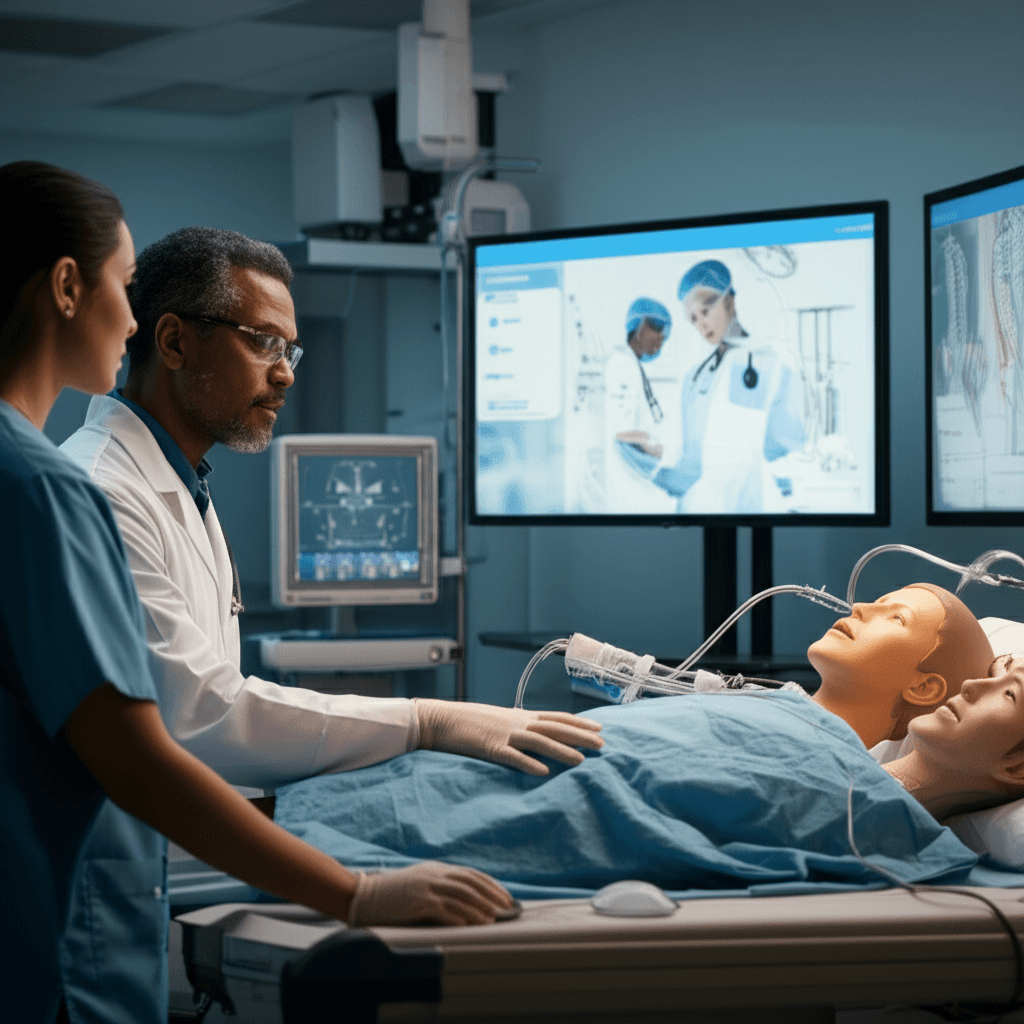
Short, focused simulation modules designed around high-priority clinical competencies can be deployed at institutional and regional levels. Platforms that enable virtual patient simulation allow self-directed CME that clinicians can complete flexibly, tracking their performance across cases and identifying areas where their clinical reasoning requires attention.