Healthcare Workforce Development at Scale Through Simulation Technology
The World Health Organization projects a global shortage of 10 million healthcare workers by 2030, concentrated in low and middle-income countries but significant across all income levels. Meeting this shortage requires training dramatically more healthcare workers than current educational infrastructure supports. Traditional apprenticeship models of clinical training — where each trainee requires one-to-one or small-group supervision from experienced clinicians — cannot scale to meet this demand. Simulation technology offers a path to training healthcare workers at greater volume without compromising the clinical competency that safe patient care requires.
The Scaling Challenge in Clinical Training
Traditional clinical training is constrained by two factors: the availability of experienced supervisors and the volume of appropriate clinical cases. Both are limited. Experienced clinicians who can supervise trainees are themselves fully occupied with patient care. Clinical cases do not arrive on an educational schedule — rare presentations required for specific competencies may not occur during a trainee's rotation. These constraints impose a ceiling on training volume that creates the global workforce shortage.
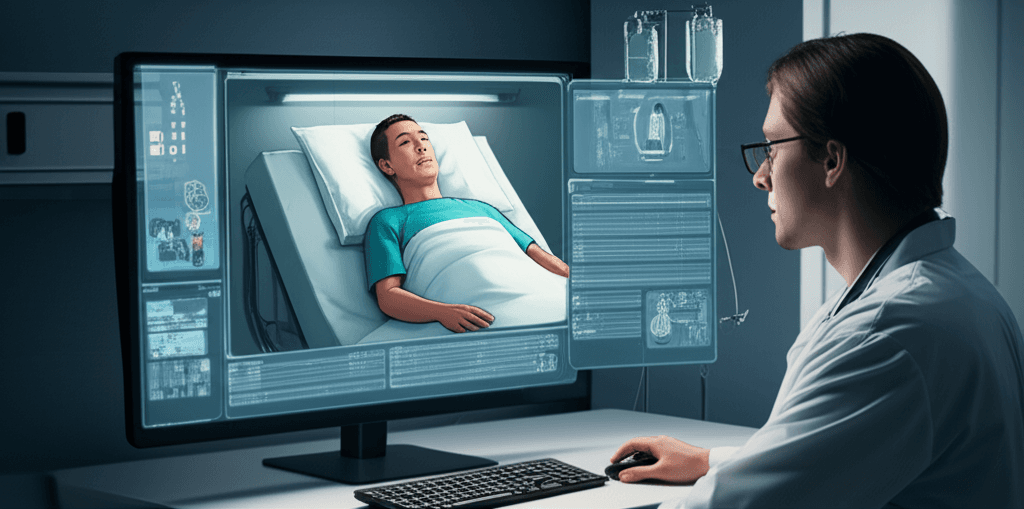
Simulation decouples training from these constraints. A single well-designed simulation platform can serve thousands of learners simultaneously without requiring proportional increases in faculty time. The clinical cases available through simulation are not limited by what arrives at a particular hospital during a particular month — a comprehensive simulation library provides consistent exposure to the full range of presentations required for clinical competency.
Digital Simulation as Infrastructure
Virtual patient simulation platforms function as educational infrastructure: a fixed investment that scales to serve growing learner populations without proportional cost increases. Once a virtual patient case library is developed, it can be accessed by any number of learners across any number of institutions simultaneously. The per-learner cost of simulation decreases as platform utilization increases, creating economic conditions that favor expansion.
For governments and health systems investing in workforce expansion, virtual patient simulation represents an efficient component of the educational infrastructure investment. The combination of simulation-based pre-clinical training with supervised clinical placement — rather than relying on clinical placement for all learning — allows programs to train more students with the same clinical placement capacity, effectively multiplying the output of clinical training infrastructure.
Quality Assurance at Scale
Scaling healthcare training without compromising quality requires robust assessment systems. Simulation provides standardized assessment that can be deployed at scale: every learner, regardless of location or training institution, faces the same assessment scenarios and is evaluated against the same performance standards. This standardization enables quality assurance at a scale that is impossible with assessment methods that depend on individual supervisor judgment.
Longitudinal performance data from simulation platforms can also identify training programs or institutions that are systematically producing under-prepared graduates, allowing targeted quality improvement interventions before graduates enter practice. This proactive quality surveillance capability is particularly valuable in workforce expansion contexts where rapid growth creates risk of quality dilution.