Virtual Patients vs Standardized Patients: Cost and Outcome Comparison
Medical schools have relied on standardized patients, trained actors who portray clinical scenarios, for decades. Standardized patient programs are well-established, faculty trust them, and they provide face-to-face clinical interaction that feels authentic. But they are also expensive, difficult to scale, and limited by the availability and consistency of human actors.
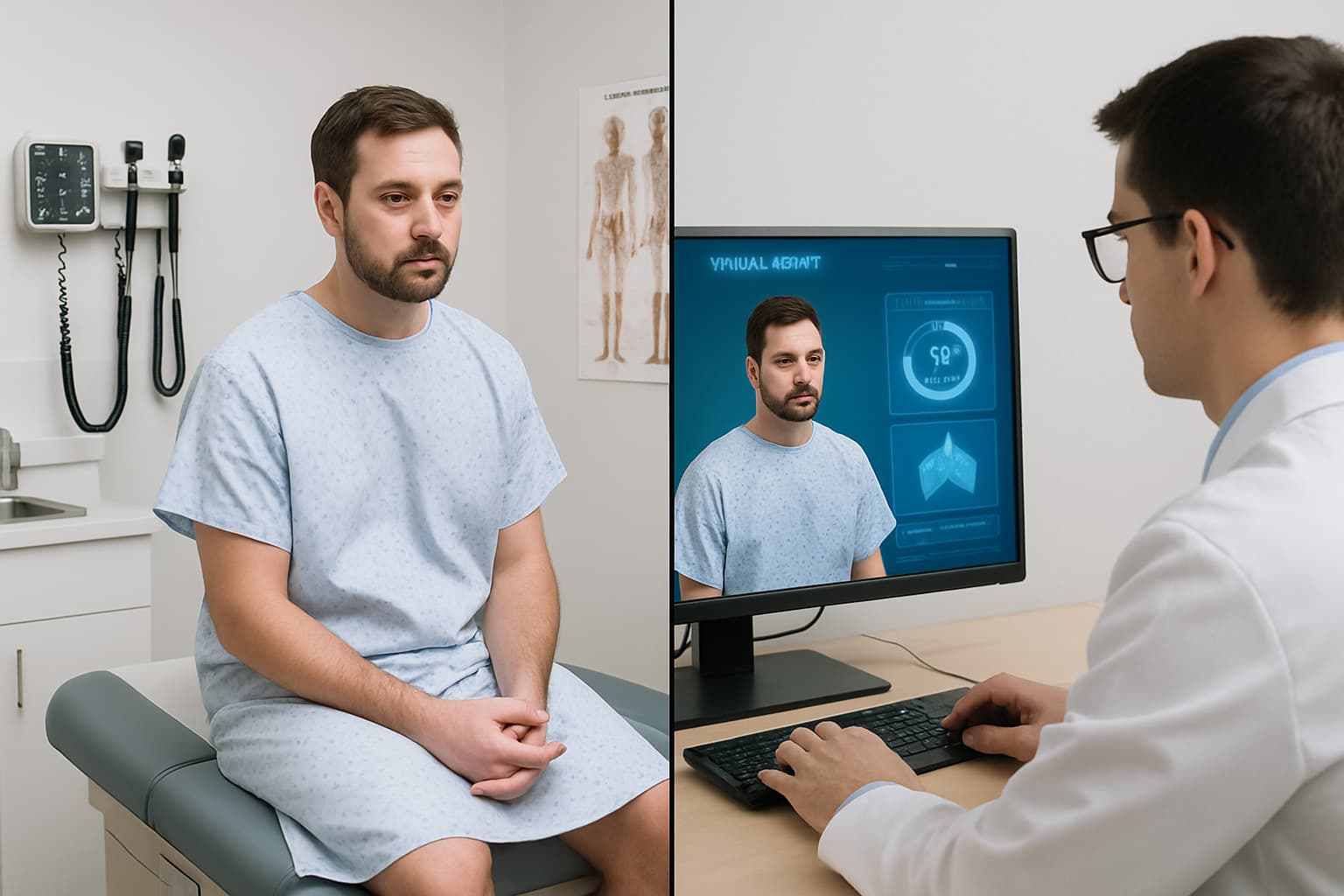
Virtual patient platforms offer an alternative approach to clinical reasoning education. The question for institutional decision-makers is not whether one approach is universally better than the other, but where each approach delivers the most educational value per dollar invested. Understanding the cost and outcome differences allows institutions to allocate their simulation budgets more effectively.
This analysis provides the financial and educational data that simulation center directors and budget committees need to make evidence-based allocation decisions. By examining both the cost structures and the outcome evidence for each approach, institutions can design a simulation portfolio that maximizes educational impact within their specific budget constraints.
The True Cost of Standardized Patient Programs
The visible costs of standardized patient programs include actor compensation, training time, and scheduling coordination. A typical standardized patient receives between fifteen and thirty dollars per hour for portrayal, plus compensation for training sessions that can span several hours per case. For a medical school running clinical skills examinations for a class of two hundred students, with each student completing multiple standardized patient encounters per year, actor compensation alone can reach hundreds of thousands of dollars annually.
Hidden costs are equally significant. Standardized patient programs require dedicated administrative staff for recruitment, scheduling, and quality assurance. They need physical examination rooms equipped with cameras and recording equipment for assessment purposes. Standardized patients need ongoing calibration to ensure consistent portrayal across students, which requires regular training sessions and quality monitoring. When a standardized patient is unavailable due to illness or scheduling conflicts, the entire session must be rescheduled or cancelled.
A comprehensive standardized patient program at a medium-sized medical school typically costs between five hundred thousand and one million dollars per year when all direct and indirect costs are included.
Virtual Patient Platform Economics
Virtual patient platforms operate on a fundamentally different cost structure. The primary cost is the software license, which is typically a fixed annual fee based on student enrollment rather than usage volume. This means the marginal cost of each additional student simulation hour approaches zero once the license is in place.
A platform offering several hundred virtual patient cases across multiple specialties might cost between thirty thousand and one hundred fifty thousand dollars per year depending on institution size and contract terms. This single investment provides unlimited clinical reasoning practice for every enrolled student, on any device, at any time, without scheduling constraints.
The cost advantage becomes dramatic at scale. If a medical school delivers ten thousand student simulation hours through virtual patients at an annual license cost of seventy-five thousand dollars, the cost is seven dollars and fifty cents per simulation hour. The same institution delivering standardized patient encounters at one hundred dollars per student per session would spend one million dollars for the same volume. This order-of-magnitude cost difference is the fundamental economic argument for virtual patient platforms.
Educational Outcomes: What the Evidence Shows
Cost analysis without outcome comparison is incomplete. The relevant question is not which approach is cheaper but which delivers better educational outcomes per dollar spent.
Standardized patients excel at developing interpersonal skills: communication, empathy, physical examination technique, and the ability to manage real-time clinical interactions with a person who responds emotionally and physically. These skills are essential for clinical practice and are difficult to develop through purely digital interactions.
Virtual patients excel at developing clinical reasoning: systematic history-taking, diagnostic test selection and interpretation, differential diagnosis formulation, and treatment planning across a breadth of clinical scenarios. A student can work through dozens of diagnostic cases in the time it takes to complete a single standardized patient encounter. The volume of practice and the breadth of clinical exposure that virtual platforms provide is impossible to match with human actors at any reasonable budget.
Published studies generally show that virtual patient training and standardized patient training produce comparable improvements in clinical knowledge and diagnostic accuracy, while standardized patients produce superior gains in communication skills and physical examination technique. This suggests the approaches are complementary rather than competitive.
Consistency and Standardization
Assessment validity depends on consistency. When students are evaluated on clinical skills, every student should face an equivalent challenge. Standardized patients, despite extensive training and calibration, introduce variability. Different actors portray the same case differently. The same actor may perform differently across a long day of repeated encounters. Fatigue, mood, and individual interpretation all affect portrayal consistency.
Virtual patients eliminate this variability entirely. Every student encounters exactly the same symptoms, the same responses, and the same clinical complexity. The platform tracks every decision against the same scoring rubric. This consistency makes virtual patient assessments more reliable and defensible, particularly for high-stakes evaluations where assessment fairness has significant consequences.
For formative assessment, where the goal is learning rather than evaluation, some variability is actually beneficial. Standardized patients who respond slightly differently encourage students to adapt their clinical approach. But for summative assessment, the consistency of virtual platforms provides a meaningful advantage.
Scalability and Access
Standardized patient programs face hard scaling limits. There are a finite number of trained actors, a finite number of examination rooms, and a finite number of hours in the day. Expanding from one hundred to two hundred encounters per week requires proportional increases in actors, rooms, and scheduling staff. These constraints create bottlenecks, particularly during examination periods when demand peaks.
Virtual patient platforms scale without proportional resource increases. Adding another hundred students requires no additional infrastructure. Students can access cases at any time, from any location, without competing for scheduled slots. A student who wants to practice cardiology cases at midnight can do so without institutional cost or scheduling coordination.
This scalability advantage is particularly significant for institutions in regions where trained standardized patient actors are scarce. Recruiting and retaining a pool of actors who can convincingly portray medical conditions in the local language and cultural context is challenging in many parts of the world. Virtual patient platforms bypass this constraint entirely.
The Optimal Mix: A Budget Allocation Framework
Rather than choosing one approach over the other, the most effective institutions use both, allocating each to the educational objectives it serves best. A practical allocation framework dedicates standardized patient encounters to communication skills assessment, physical examination skills, and scenarios where interpersonal interaction is the primary learning objective. Virtual patient platforms handle clinical reasoning development, diagnostic skill building, and broad specialty exposure.
Under this framework, an institution might allocate thirty percent of its simulation budget to standardized patients for high-value interpersonal skills encounters and seventy percent to virtual patient platforms for clinical reasoning education at scale. The exact ratio depends on curricular emphasis, but the principle is consistent: use the most cost-effective tool for each specific learning objective.
This mixed approach delivers the broadest educational impact per dollar, provides students with both the interpersonal and the analytical skills they need for clinical practice, and ensures that neither approach is asked to do something it does poorly.
Rare Conditions and Breadth of Clinical Exposure
One advantage of virtual patients that is often underappreciated in cost discussions is the ability to expose students to rare clinical conditions that standardized patients simply cannot portray. A standardized patient can convincingly present common conditions like chest pain or shortness of breath, but cannot realistically simulate the physical findings of rare hematological disorders, unusual dermatological presentations, or complex multi-system diseases.
Virtual patient platforms with large case libraries include rare conditions that students might encounter only once or twice during their entire clinical training. This exposure matters because diagnostic accuracy for rare conditions depends heavily on prior exposure. A student who has worked through a virtual case of pheochromocytoma or Addison disease will recognize the presentation pattern when they encounter it in clinical practice, potentially catching a diagnosis that would otherwise be missed or delayed.
From a cost perspective, the marginal cost of adding rare disease cases to a virtual patient platform is essentially zero once the platform license is in place. Creating a standardized patient scenario for a rare condition requires custom case development, specialized actor training, and potentially props or makeup. For institutions seeking to maximize the breadth of clinical exposure per educational dollar, virtual patients for rare conditions and standardized patients for communication-intensive common conditions represents the optimal allocation.